Ruka hadi maudhui
Anza

Solutions · For partners

Better outcomes. Tighter programmes. Data you can decide on.

Kurasa for partners is for the people who fund, convene or hold a family of schools: development partners, school associations, faith-based organisations, and others doing similar work. The question is not whether teachers can file another form. It is whether learners are getting better, whether the programme is actually running, and whether you can see that in time to act.

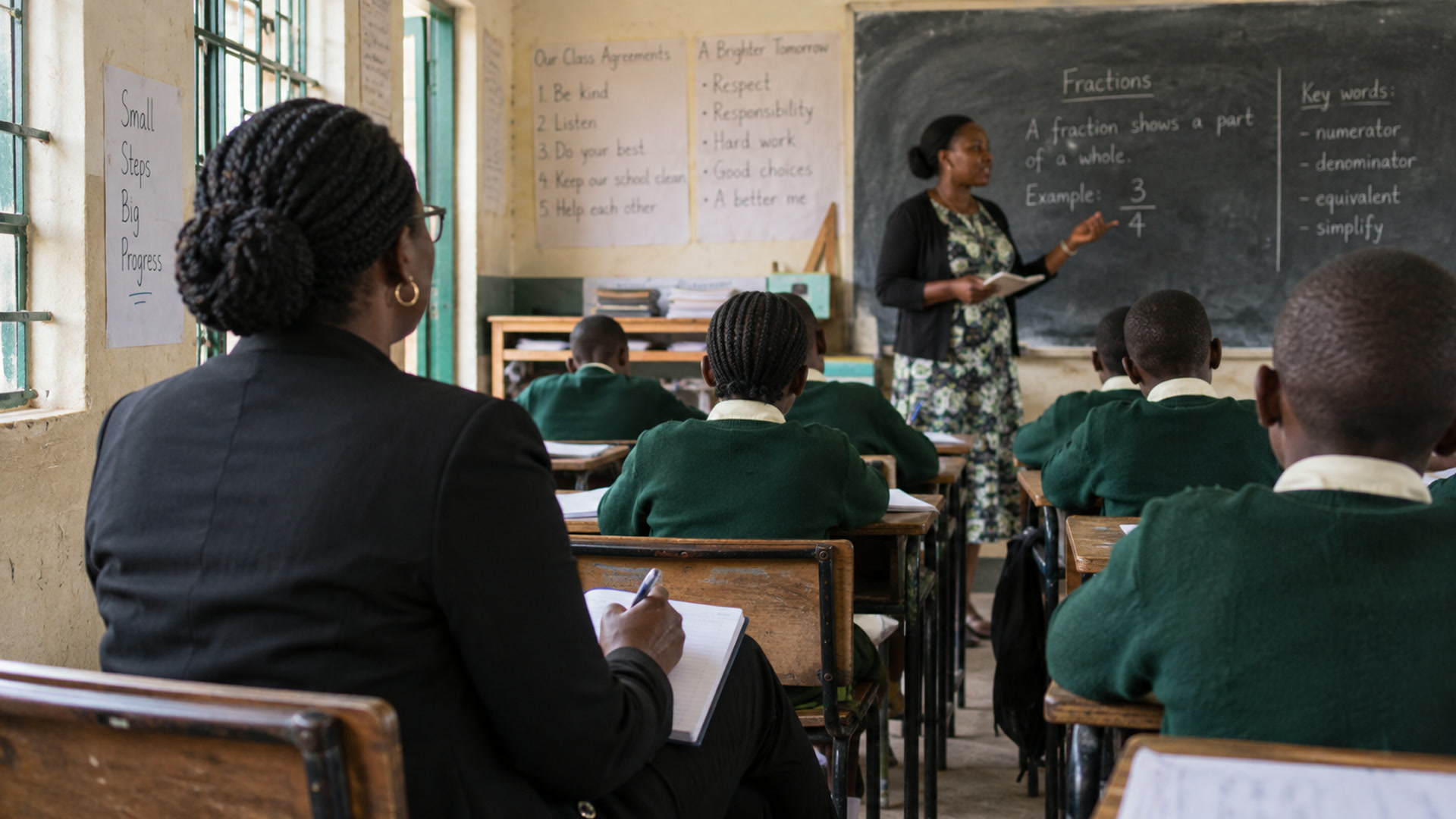
A partner sits at the back of a live lesson, observing teaching rather than running a separate tent.

Who this is for

If you sit above many classrooms, this is your page.

Development partners

Funders, NGOs and implementers who need a programme to leave learning evidence in the school — not a parallel workshop stack and a PDF at close-out.

School associations

Membership bodies that support many schools and need a comparable picture of teaching and attainment, not a stack of anecdotes.

Faith-based school networks

Dioceses, missions and other authorities that manage a family of schools. The classroom still belongs to the teacher; you need to see whether the work happened.

Like-minded partners — county programmes, research groups, teacher-service collaborations — use the same door. If you licence or inspect schools, start with governments and KISEL. If you already funded the proof, the distinguished partners page holds those stories. KISEL · Distinguished partners

What partners ask for

What a programme is judged on.

Outcomes

Did learners get better?

Formative evidence against curriculum indicators — including foundational literacy and numeracy — so a programme can say who is below, approaching, meeting or exceeding, and who still needs support.

Programmes

Is the work actually running?

Optimise against the school week: plan the lesson, teach it as a recorded session, close the indicators. A programme that cannot live in that loop will not survive a public-school term.

Decisions

Can you act this month?

Coverage is not proficiency. Leaders get both: whether the syllabus was evidenced, and whether learners met the bar — rolled up by school, grade or network when you hold more than one classroom.
Foundational learning

Foundational literacy and numeracy sit on this page on purpose.

Early-grade reading and number sense are not a side project. They are the indicators a teacher is already supposed to plan, teach and assess — then the practice a learner can keep after school.

In Kirinyaga County in 2023 and 2024, foundational learning evidence was generated with Brink and the Jacobs Foundation, in collaboration with the Teachers Service Commission. That trail is why Kurasa now sits in public schools at county scale.

In the lesson

Plan–Teach–Assess against official strands and indicators. A substrand in literacy or number is complete only when the expected indicators have closed formative evidence — not when a workshop was attended.

The PTA model

Foundational numeracy

PSL Daily Challenge is five short curriculum questions a day — number sense kept as a habit, not a camp. Termly PSL sittings diagnose mathematics across schools so the next reteach is named, not guessed.

Daily Challenge · Problem Solvers League

Across a network

Associations, dioceses and other school bodies get one summative picture from the records schools already produce. That is how a programme decides where to put support next term.

PSL Summative

~400 Public schools in Kenya on that trail
150k+ Learners currently served

How a programme uses Kurasa

Do not invent a second M&E system. Use the classroom record.

See teaching fidelity

Planned but not delivered is the core failure. PTA shows whether lessons were taught, not only whether a scheme exists.

See learning

Closed formative batches on indicators, including foundational literacy and numeracy. Learners at 2 or below are a support list — not a pass/fail exam.

Decide at the right grain

School, grade, class, or the whole association. Coverage and attainment sit together so a high mark-rate cannot hide learners still below the bar.

Kurasa for schools

A programme conversation

This is not a teacher signup.

We set Kurasa up with the body that holds the schools: the association, the diocese, the implementing partner, the county programme. Teachers then work the week they already have.

Write to the team. Bring the schools, the grades, and the outcomes you are accountable for — including foundational literacy and numeracy if that is the brief.

Strategic partnerships

How we partner.

We are selective so teacher experience stays intact. Three doors, one classroom record.

Content partners

  • Textbook publishers, curriculum designers and assessment creators.
  • Integration: quality content inside Workspace and PSL.
  • Content partnerships are in conversation — we announce when ready.

Distribution partners

  • KEPSHA, NaSIA, ministry contacts, EdTech Hub, ESDEV Foundation.
  • Reach schools and districts through structures teachers already trust.
  • Programme setup with the body that holds many schools.

Technology partners

  • LMS, analytics and parent-communication platforms that serve the same teacher base.
  • API integrations for approved partners.
  • We protect the weekday experience over feature sprawl.

What we look for: organisations with existing teacher or school relationships; content creators in maths, literacy and STEM; distribution into public systems; technology providers who already serve teachers.

If you serve schools or teachers in Kenya, Rwanda or Ghana, start a conversation.

Contact partnerships

Next

Put the programme on the same trail as the lesson.

If learners are not improving, the dashboard will show it. That is the point.