Skip to content

PSL Mathematics Contest

PSL Mathematics Contest 2026: Acacia Crest Edition

Twelve schools brought Grades 7, 8 and 9 to a paper that asked for reasoning, not only recall. Two hundred and seven scored scripts were analysed — by learner, team, school, grade and strand — so teachers could see where the work is landing and where it still needs teaching.

Figures from the published contest results. View the official results

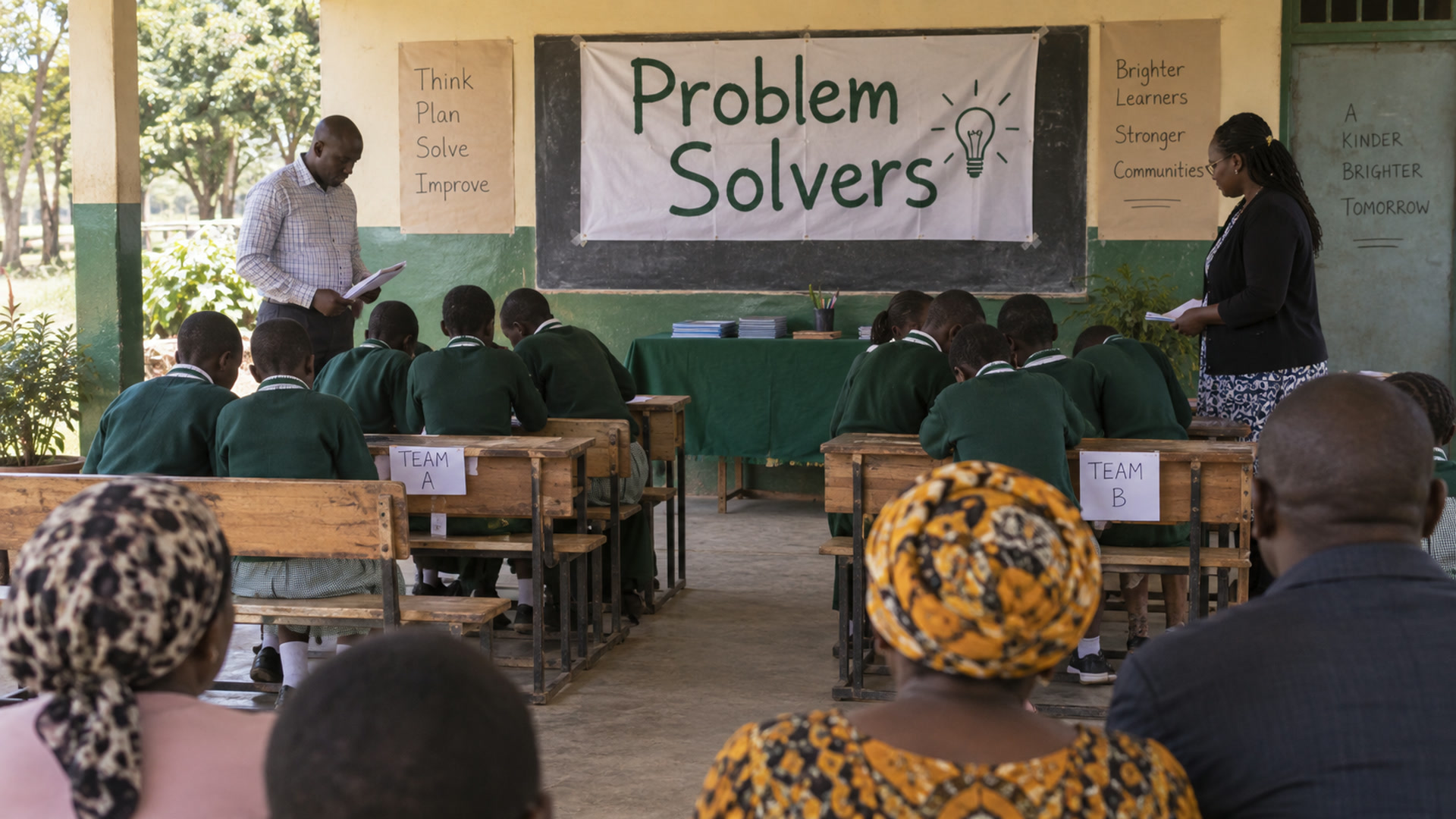
A modest school contest with learners at benches and teachers looking on.
12 Participating schools
207 Scored scripts, Grades 7–9
37.3% Overall average — a suitably challenging paper
88% Highest score, Judy Seleina, Chuna Junior School

The sitting

A contest that rewarded real problem-solving.

The contest was written to go beyond routine classroom drills. Learners had to reason, calculate, model real-life situations, interpret multi-step word problems, apply formulas, and show their working across number, algebra, geometry, measurement, probability, ratio, proportion and commercial arithmetic.

That is the point of a PSL contest sitting: not a stage show, but a diagnostic that still feels like a public moment. Schools can see who is showing exceptional promise, which teams are consistent, which grades need support, and which strands are blocking higher achievement — while sitting alongside other participating schools.

By grade

Where the paper landed.

Grade Scored scripts Average Highest
Grade 7 54 39.3% 88%
Grade 8 74 32.7% 69%
Grade 9 79 40.3% 86%

Grade 9 recorded the highest average. Grade 7 produced the top overall learner.

Schools

Leading schools by average score.

# School Average Top learner
1 Cornerstone School 58.4% Tashley Waithira, 73%
2 Chuna Junior School 57.0% Judy Seleina, 88%
3 Mountain View 54.2% Jimmy Carter, 80%
4 Acacia Crest Academy 53.8% Randall Henry, 86%
5 Corner Brook School 39.9% Ryan Huri, 68%

Cornerstone School led on school average. Chuna Junior School produced both the top team and the top overall learner.

Teams

The highest-performing teams.

# Team Average
1 Chuna Junior School – Team 2 67.2%
2 Acacia Crest Academy – Team 2 64.5%
3 Chuna Junior School – Team 3 59.0%
4 Chuna Junior School – Team 1 58.8%
5 Acacia Crest Academy – Ungrouped 58.4%
6 Cornerstone School – Team 1 58.4%
7 Mountain View – T-41 56.8%
8 Mountain View – T-42 55.8%

Learners

Top learners of the contest.

# Learner School Grade Score
1 Judy Seleina Chuna Junior School 7 88%
2 Randall Henry Acacia Crest Academy 9 86%
3 Jimmy Carter Mountain View 7 80%
4 Jason Mbaita Chuna Junior School 9 77%
4 Kevin Nganga Acacia Crest Academy 9 77%
6 Alvin Kipchirchir Chuna Junior School 7 76%
7 Tashley Waithira Cornerstone School 9 73%
8 Fridah Waridi Chuna Junior School 9 70%
8 Valeria Wanjiku Mountain View 9 70%
10 Clifford Munene Mountain View 8 69%
10 Liam Saolla Acacia Crest Academy 8 69%

Names and scores are from the published contest results.

Strands

What the scripts say about strengths.

The strongest strand overall was Number & Numeration. Learners were relatively more comfortable with place value, fractions, integer operations, ratio-style questions and basic computation. Algebra was the weakest broad strand.

  1. Number & Numeration 47.6%
  2. Data & Probability 43.4%
  3. Ratio & Proportion 37.4%
  4. Geometry & Measurement 35.5%
  5. Commercial Arithmetic 33.4%
  6. Algebra 25.1%

Gaps to teach next

The paper was diagnostic, not only competitive.

  1. Algebraic reasoning — forming equations from word problems, simultaneous equations, age problems, inequalities and graph interpretation.
  2. Geometry and measurement in applied contexts — recalling a formula was easier than using it in a multi-step situation (painted wall area, composite surface area, cylinder capacity, slabs, solid geometry).
  3. Commercial arithmetic — salary, commission, exchange rates, duty and percentage contexts exposed gaps in financial reasoning.
  4. Work-rate and proportional reasoning — people, time, work done, pipes and changing rates were especially demanding.

The Acacia Crest sitting combined individual ranking, team competition, school comparison, grade-level analysis, strand diagnosis and question-level review. That combination is the PSL idea in public: celebrate the learners who stretched, and send every participating school home with something a teacher can reteach next week.

Next

Keep the habit going.

The same daily five that feeds PSL is waiting at home. The full rankings, teams and strand notes live on the contest results page.