Process, not results.
The work of teaching, in your school’s context.
A lesson prepared. A learner listened to. A teaching decision made while there is still time to act. Kurasa starts with these everyday practices. Choose your country to explore a way of working grounded in your curriculum, your classroom language and your school week.
Choose your country
Start with the curriculum you teach.
CBC · school accounts available
Kenya
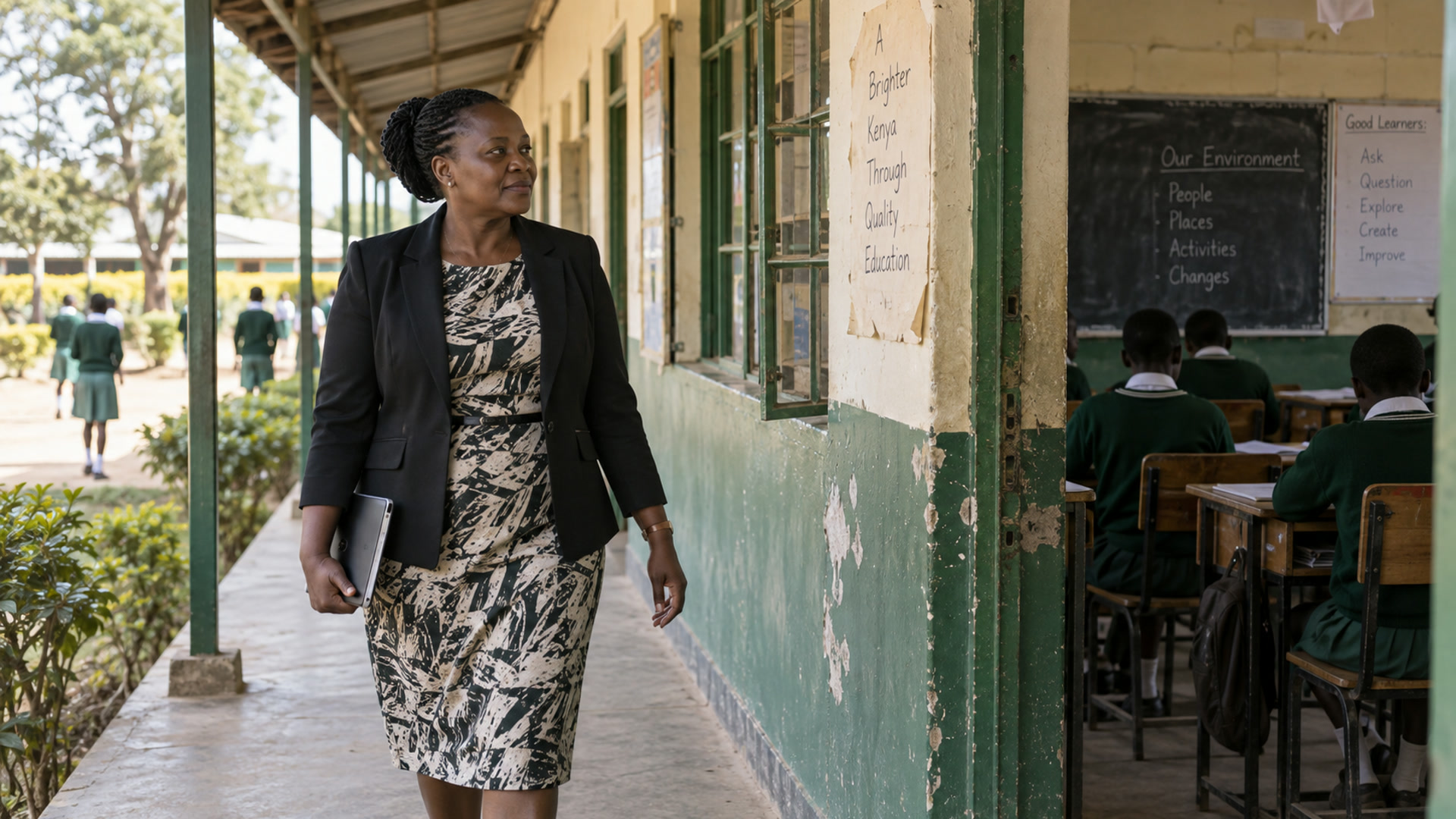
Plan by learning area, strand and substrand. Take the register, record what learners try, and use those notes to prepare the next lesson.
Competence-based teaching · enquire
Tanzania
Work from your TIE syllabus and classroom language. Connect lesson preparation, practical activities and continuous assessment in the teacher’s week.
NCDC curricula · enquire
Uganda
Follow a lower secondary activity from preparation to feedback, or begin with the themes and familiar language of a P1–P3 classroom.
Anglophone and francophone subsystems · French and English
Cameroon
Choose French or English. Start from the subsystem and the programme, then prepare a task and record the next step.
CAPS · enquire
South Africa
Work from CAPS and your Annual Teaching Plan. Keep lesson preparation, daily assessment and follow-up connected across the term.
Curriculum planning and assessment · enquire
Malawi
Start with the syllabus your class is using. Prepare the activity, listen to learners and use continuous assessment to plan the next school day.
Competence Based Curriculum · enquire
Zambia
Start from a Curriculum Development Centre syllabus. Zambia’s CBC is its own document, with its own languages of instruction.
Heritage-Based Curriculum · enquire
Zimbabwe
Bring the learning-area syllabus your school is teaching under the Ministry of Primary and Secondary Education.
National Curriculum for Basic Education · enquire
Namibia
Plan from the phase and the end-of-phase competencies in the NIED curriculum, and name the language of instruction.
Programme officiel · enquire
Senegal
Bring the programme for your cycle. Choose French or English, then name the class and teaching language; one APC document does not cover every school.
Approche par les compétences · enquire
Côte d'Ivoire
Start from the ministry programme for your level. Choose the French or English guide, and name the language used in your classroom.
Programmes d’études par compétences · enquire
Benin
Name the cycle and bring the programme your teachers use. Choose the French or English guide and share the classroom language.
Approche par compétences · enquire
Burkina Faso
Bring the current programme for your cycle. Choose the French or English guide and name the language used for teaching.
MATATAG learning competencies · enquire
Philippines
Start from the DepEd curriculum guide for the grade and learning area, and say which language that class uses.
Name the board · enquire
India
The NCF-SE is a framework. A school still teaches CBSE, CISCE or a state board. Tell us which one.
2018 general education curriculum · enquire
Vietnam
Begin with the qualities and competencies in the national curriculum. Choose the Vietnamese or English guide and bring a lesson plan.
Currículo Nacional · enquire
Peru
Plan from the competencias in Peru’s national curriculum. Choose the Spanish or English guide and bring an example learning activity.
BNCC · enquire
Brazil
Start from the competências in the Base Nacional Comum Curricular. Choose the Portuguese or English guide and bring the curriculum of your school network.
Key competencies · enquire
New Zealand
Plan with The New Zealand Curriculum or Te Marautanga o Aotearoa, connecting learning areas or wāhanga ako with classroom observations and the next teaching step.
Standards-Based Curriculum and CCP
Ghana
Bring lesson notes, content standards and indicators into the same routine. Explore the classroom practice documented in Ghana’s TLAP pilot.
Competence-Based Curriculum · enquire
Rwanda
Plan around a unit’s key competence, create space for learner participation, and carry formative assessment into the next lesson.
Our way of working
Plan. Teach. Assess. Return to the plan.
Our language is about the process: what a teacher prepares, what happens in the lesson, and how the next lesson responds. Curriculum terms differ across countries. The attention given to each learner belongs in every classroom.
- Plan from the official curriculum and the materials you have.
- Teach, take attendance and notice how learners approach the task.
- Record what you observed, give feedback and choose the next teaching step.
Language
Begin with the language of your classroom.
These country guides are in English. When you contact us, tell us the language used for teaching, the level you work with and the support your staff need. We will discuss those requirements alongside curriculum setup and connectivity.
Take the first step
Bring us one ordinary school week.
Start with the lessons, registers and assessment notes your teachers already use. Kenya schools can open an account. Schools and programmes elsewhere can request a walkthrough from their country page.